
Webinar (October 2015) on the PCI DSS 3.0 requirements for Oracle E-Business Suite, whose default settings don’t meet them, and why the whole application is in scope if any cardholder data is present.
 Play the Recording: Looking at Oracle E-Business Suite and PCI Compliance
Achieving and keeping PCI compliance is a big task, and the default settings of Oracle E-Business Suite do not meet the Payment Card Industry Data Security Standard (PCI DSS) 3.0. Credit card processing may be only a minor feature of EBS, but if any cardholder data is present, the entire application must comply.
We walk through the PCI requirements for EBS, the credit card encryption in R12 Oracle Payments and the places card data hides. CardConnect, an integrator for payment security, then explains the kinds of tokens and why tokenization removes EBS from PCI scope only with off-site hosting. EBS teams can then find their card data and weigh encrypting it against tokenizing it.
Key Points
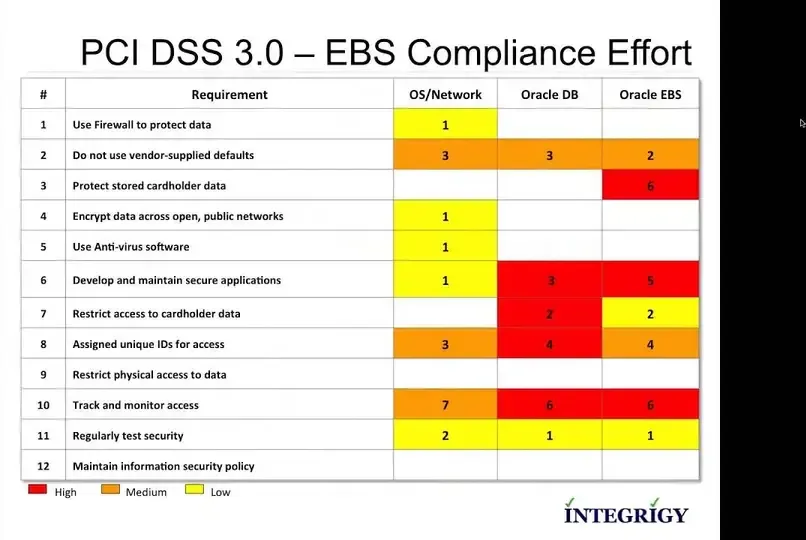
- Beyond encryption, PCI DSS 3.0, since replaced by PCI DSS 4.0, requires applying application and database CPU security patches within 30 days of release (Requirement 6), no generic accounts and strict password complexity (8), automated audit trails with daily log review (10), and an annual application penetration test, quarterly vulnerability scans and file integrity monitoring (11).
- R12 Oracle Payments, which supersedes the 11i functionality, keeps credit cards for modules such as Order Management, iStore, iReceivables and Service Contracts in its Secure Payments Repository, whose PCI encryption and masking are disabled by default; enabling them takes three steps: create the payment wallet, set the protection configuration options and encrypt existing cardholder data.
- Card data sits in tables such as
iby_security_segments(encrypted),iby_creditcard,ap_bank_accounts_all,oe_order_headers_all,aso_payments,oks_k_headers_*andiby_trxn_summaries_all, and can also turn up in custom and interface tables, DBA "maintenance" copies such asiby.iby_security_segments_011510, interface files and log files, such as those of Oracle Payments. - Requirement 6.4.3 bars live cardholder data from test and development and 3.5 requires protecting encryption keys, so for each non-production instance, rotate and securely wipe the production payment wallet, reset the wallet location, and remove, purge or scramble the production cardholder data.
- Tokens can be random, and so irreversible, or derivative, can carry intelligence such as the Luhn test and BIN recognition, and a "high value" token can be persistent or individually administered.
- Tokenization is only the first step: without the second, off-site vaulted hosting, Oracle is still in PCI scope, and once existing data is secured, all new card data must be tokenized before it enters the network.