
Webinar on the PCI DSS 3.0 requirements for Oracle E-Business Suite implementations that store, process or transmit cardholder data, and an order in which to tackle them, from native encryption to configuration, passwords and auditing.
 Play the Recording: PCI DSS 3.0 Compliance and the Oracle E-Business Suite
Oracle E-Business Suite implementations that "store, process, or transmit cardholder data" must comply with the Payment Card Industry Data Security Standard (PCI DSS) 3.0 regardless of size or transaction volume, and all 12 of its requirements are mandatory at every merchant compliance level. PCI DSS focuses on securing cardholder data but puts significant emphasis on general IT security and controls, and a standard EBS installation is not compliant.
We review credit card processing and encryption in EBS and the key PCI DSS 3.0 requirements for it, with an order in which to tackle them. EBS teams can then plan their compliance work and the periodic tasks that keep it in place.
Key Points
- Our recommended approach to PCI DSS 3.0, since replaced by PCI DSS 4.0, takes the highest-risk, lowest-effort EBS requirements first: native EBS encryption (3.4), which the PCI DSS Prioritized Approach leaves to its fifth milestone, then hardening the configuration (2.x), Oracle CPUs (6.2), auditing sent to a logging server (10.x), and purging and scrambling (3.1).
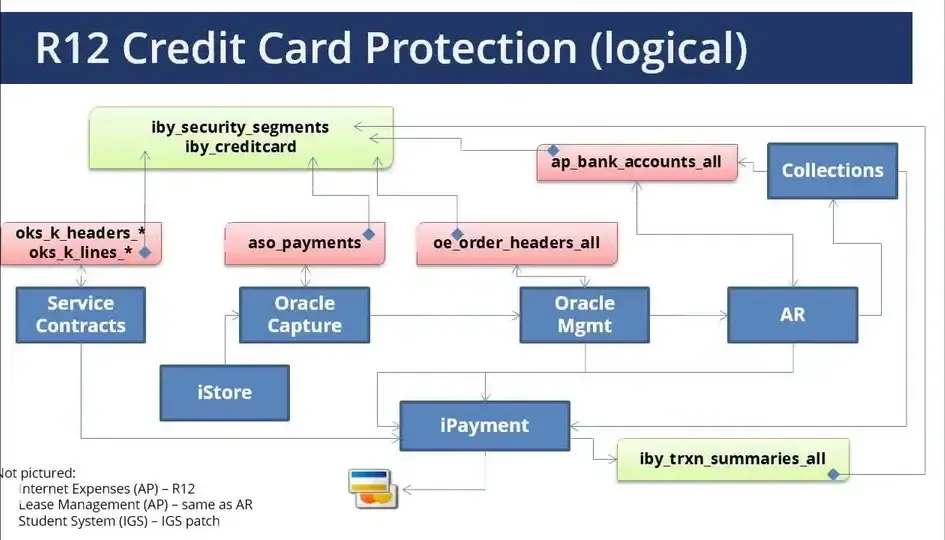
- R12 Oracle Payments encrypts card numbers in the application, much better than Oracle Transparent Data Encryption (TDE), with a master key in a payment wallet kept secure, unshared and backed up separately; existing card data is encrypted only by running "Encrypt Sensitive Data Request Set", plus "Upgrade Encrypted Credit Cards" with full encryption.
- Under 3.4, find all card data, as card data in logs, such as those of Oracle Payments and Apache, is a major issue; under 3.1, keep it less than 18 months, purging only the card number, not the transaction, with custom code, since Oracle supports no purge; and rotate the wallet keys annually (3.6).
- Change default database and seeded application passwords (2.1), and under Requirement 8 enforce database passwords through profiles with a custom password validation function, for length of at least 7, complexity, expiry every 90 days, no reuse within 450 days and a failure limit of at most 6, with a 15-minute session time-out.
- Use Oracle's Secure Configuration Guide for Oracle EBS as the configuration standard (2.2), encrypt all network traffic with SSL (today TLS), SSH and SQL*Net encryption, since administrator traffic must be encrypted (2.3), and protect external modules such as iSupplier and iStore with annual penetration tests or a web application firewall, such as our AppDefend (6.6).
- Auditing EBS is problematic, as generic privileged accounts (APPS, SYS) are used and DBAs can manipulate the audit trail, so under 10.5 keep DBAs out of
SYS.AUD$, part of traditional auditing, which Oracle desupported in 23ai (now 26ai) in favor of Unified Auditing, and under 10.7 retain audit trails at least one year.