
Webinar on common mistakes when deploying Oracle E-Business Suite Internet modules such as iSupplier, iRecruitment and iStore to a DMZ, which can expose financial and HR data to the Internet.
 Play the Recording: Common Mistakes When Deploying Oracle E-Business Suite to the Internet
When you deploy Internet-enabled Oracle E-Business Suite modules such as iSupplier, iRecruitment or iStore externally in a DMZ, you potentially expose your entire environment to the Internet, including all your financial and HR data.
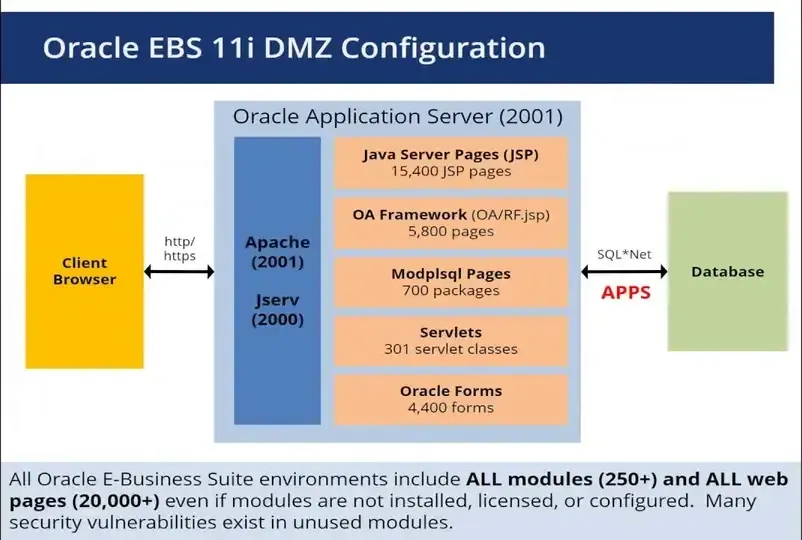
Every EBS environment includes all 250+ modules and 20,000+ web pages, even modules not installed, licensed or configured, and many vulnerabilities are in unused modules. We discuss the risks of deploying EBS externally and the common mistakes found in these deployments, in the DMZ configuration and URL Firewall, Critical Patch Updates and SSL. EBS DBAs and security teams can then check their external deployments against Oracle's DMZ notes and close the gaps.
Key Points
- Oracle certifies only some modules for a DMZ, those with no forms and with URL Firewall rules, such as iSupplier Portal (POS), iRecruitment (IRC) and Oracle iStore (IBE); follow every step of its DMZ note: MOS Note ID 1375670.1 for 12.2, or 380490.1 for 12.1/12.0 and 287176.1 for 11i, releases now in Sustaining Support.
- High-risk mistakes are a URL Firewall (Appendix E, a mandatory whitelist in
url_fw.conf) not enabled or incorrectly enabled, which exposes 20,000 EBS web pages to the Internet, many possibly with unpatched vulnerabilities or diagnostics, and a DMZ server not marked as external, which leaves the URL Firewall and Node Trust Level off. - Medium-risk mistakes are allowing too many responsibilities at the external Node Trust Level, which exposes unnecessary OA Framework pages (DMZ Step 5.2 sets
NODE_TRUST_LEVELto EXTERNAL on the external server and Step 5.3 limits its responsibilities), and leavingFND_DIAGNOSTICSenabled, which gives an attacker significant information on the EBS configuration. - Not routinely applying Critical Patch Updates is a critical-risk mistake: Oracle fixed 581 EBS vulnerabilities from January 2005 to January 2017, including about 130 SQL injection and 220 cross-site scripting flaws, and our sample risk mapping (last CPU July 2015) counted 42 bugs exploitable by unauthenticated external users even with the URL Firewall enabled.
- Some vulnerabilities can be exploited even with the URL Firewall and Node Trust Level properly configured, and most EBS vulnerabilities are not blocked by commercial web application firewalls, so use an EBS-specific tool to block known and 0-day vulnerabilities, such as our AppDefend, which runs inside EBS as a servlet filter.
- Encrypt all end-user traffic, since plain HTTP sends EBS passwords in clear text, and terminate SSL on the load balancer or reverse proxy, as EBS native SSL is slow to support newer protocols and ciphers; if you use native SSL, keep it patched and disable SSLv2, SSLv3, weak ciphers and, today, TLS 1.0 and 1.1.