
Webinar on how targeted attacks find and break into Oracle databases inside the network, with a framework and techniques to prevent and detect them.
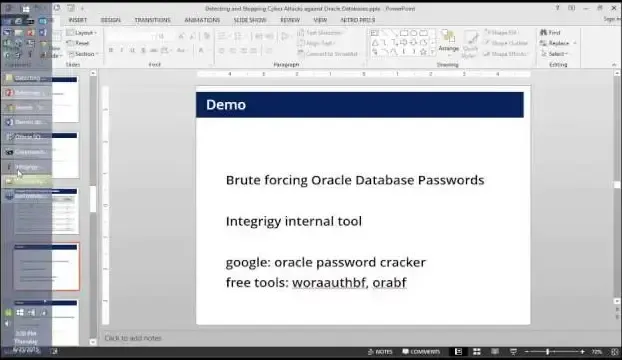 Play the Recording: Detecting and Stopping Cyber Attacks against Oracle Databases
Oracle databases are a target of cyber attacks by hackers looking for sensitive data such as credit card numbers and the personally identifiable information used in identity theft. Even though databases are not externally accessible, they are still targets, since a targeted attack breaches the network perimeter and then looks for high-value targets on the internal network.
We show what stolen data is worth, demonstrate how attackers find and break into Oracle databases, and present a framework and techniques for preventing and detecting these attacks. DBAs and security teams can then limit access to their databases, close the common weaknesses and set up auditing that detects an attack.
Key Points
- A targeted attack breaches the perimeter by network compromise, phishing or social engineering, persists, moves laterally, finds its data and exfiltrates it, locating databases through
tnsnames.orafiles andalter user ... identified bystatements in internal repositories, passwords saved in SQL Developer, and Nmap scans of ports 1521 to 1529, which are very noisy. - In a sample of 120 production databases, DBSNMP still had its default password in 52%, OUTLN in 43% and CTXSYS in 32%, so check passwords constantly with more than one tool:
DBA_USERS_WITH_DEFPWDchecks a limited set of accounts with a single password each, while AppSentry checks all accounts against over 1 million passwords. - TNS poisoning (CVE-2012-1675, CVSS 2.0 base score 7.5) lets an unauthenticated attacker register with the listener so that user connections are "load balanced" to the attacker's proxy; it affects all versions and is not patched by an SPU or PSU, so secure the listener with SSL, Class of Secure Transport (COST) or Valid Node Checking Registration (VNCR).
- The stealth password cracking bug (CVE-2012-3137, CVSS 2.0 base score 10.0), a flaw in the 11g O5Logon protocol, lets an attacker capture the
auth_sesskeywith a SQL*Net client trace or Nmap'soracle-brute-stealthscript and brute-force the password with John the Ripper, affecting 11.1.0.x through 11.2.0.3 databases that use "11G" passwords, all now desupported. - Our #1 recommendation is to limit direct database access with firewalls in front of the data center, network ACLs, TNS invited nodes, Oracle Connection Manager or Oracle Database Firewall, with DBAs using bastion hosts, then apply Critical Patch Updates regularly on all databases, enforce strong passwords with database profiles, and harden configurations and validate them regularly.
- Our auditing and logging framework maps 14 foundation security events, from logins to privileged commands, to PCI DSS 10.2, SOX, HIPAA, ISO 27001 and FISMA, centralizes database and application logs, and starts database auditing with
AUDIToptions such assession,user,roleandsysdba, traditional auditing which Oracle desupported in 23ai (now 26ai) in favor of Unified Auditing.