
First webinar in the Hidden Security Threats series with ERP Risk Advisors, on the security threats and risks in Oracle E-Business Suite that internal auditors often overlook.
 Play the Recording: Hidden Security Threats in Oracle E-Business Suite
ERP Risk Advisors and Integrigy present the first in a series of webinars on the hidden security threats found in Oracle E-Business Suite. Internal auditors often focus on the financial aspects, segregation of duties and application controls when auditing EBS, yet most environments hold security threats and risks that audits overlook.
We look at five: application password decryption, user profile options, application diagnostics, sensitive administrative page access and database account passwords. Auditors can then add these risks to their EBS audits. The series continues with Sensitive Administrative Pages in Oracle E-Business Suite and Oracle E-Business Suite Account Password Decryption Threat Explored.
Key Points
- Profile options, 8907 in the R12 instance shown, can be set through the System Profile Values form and also the User Profile Values form, which risks overriding controls, so remove access to the User Profile Values form or personalize it to allow only low-risk profile options.
- Perform a risk assessment to decide which profile options go through change management, or put all of them through it, and document that; build a detailed audit trail of changes with a log-based or trigger-based auditing solution, trace actual changes back to approved ones, and test that the procedures were followed.
- Application Diagnostics, enabled through the Utilities: Diagnostics profile option, is back-door access to tables that can maintain data not visible through forms, such as IDs, and corrupt data, so in production allow it to no one other than those who already have the APPS password.
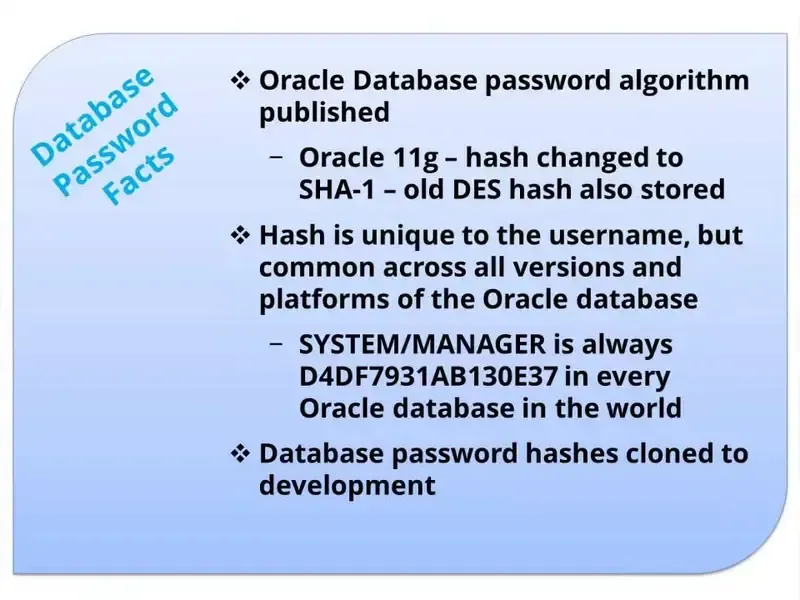
- An EBS database has 300+ accounts by default, one for each module (GL=GL) and a few extras such as APPS, almost all with the username as the default password and all with significant privileges, and upgrades and patching add more, such as CA, DDR, DNA, DPP, FTP and GMO in the R12.1 upgrade.
- Database password hashes read from
user$in a development clone can be brute forced offline over a weekend or a month, so check every account: Oracle'sDBA_USERS_WITH_DEFPWDcovers only a limited set of accounts with a single password each, while AppSentry checks all database accounts against lists of over 1 million passwords. - Security is complicated, ever-changing and not a one-time event, and Oracle's security documents cannot be relied upon as complete.