
Webinar for internal auditors on the basic security every Oracle E-Business Suite system should have, covering SOX, PCI and privacy compliance, protecting sensitive data, best practices and key risks.
 Play the Recording: Internal Auditor Primer: Oracle E-Business Suite Security Risks
Every Oracle E-Business Suite (EBS) implementation should have a basic level of security, and internal auditors can check for it. We cover five topics: compliance issues regarding SOX, PCI and privacy laws; protecting sensitive data within EBS; best practices for securing EBS; concerns with user privileges and excessive access; and secure external access to EBS modules such as iStore, iSupplier, iRecruitment and iSupport.
Internal auditors can then review these risks with DBAs and IT security, who must work with them to keep EBS secure and compliant. Our whitepaper Oracle E-Business Suite: Credit Cards and PCI Compliance covers PCI in more depth.
Key Points
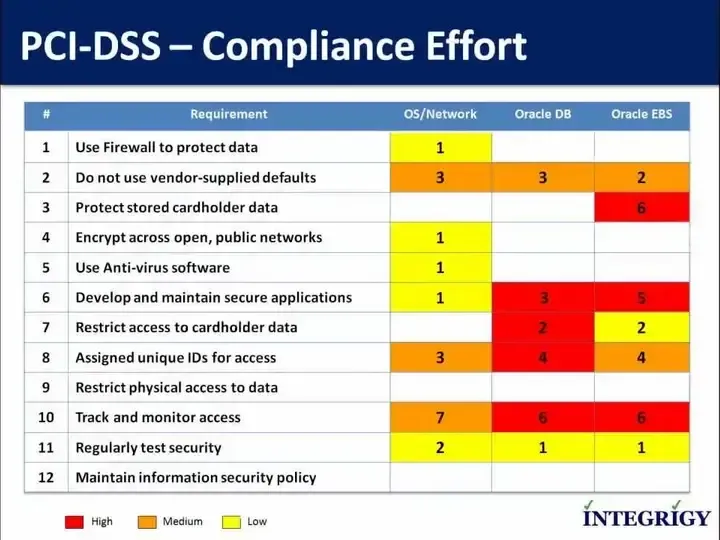
- SOX concerns database object, structure and configuration changes, user and privilege creation, deletion and modification, and reports for sampling changes against change tickets; PCI DSS sets 12 stringent security requirements; and privacy laws, such as California's and Massachusetts', concern read access to sensitive data such as national identifiers and bank account numbers.
- PCI DSS 6.1, in a version since replaced by 4.0, required installing critical security patches within one month of release, yet few Oracle customers install patches within 30 days and most are 1 to 2 quarters behind, so the business must prioritize applying security patches despite the effort to functionally test them and the downtime.
- Our key security risks are exploitation of Oracle security vulnerabilities (apply security patches, limit direct connectivity to the database and prohibit individuals from using generic accounts), brute forcing of database passwords (limit access to password hashes and change all database passwords in test and development) and decryption of EBS passwords (apply the latest EBS password patches).
- All data is duplicated in development and test databases, so scramble all sensitive data in every non-production database and periodically check for unscrambled data, often in custom, interface and temporary tables; EBS natively encrypts only credit card numbers and seldom purges or archives data, while 1 to 2 years' retention is recommended for PCI compliance.
- DBAs must use generic, privileged database accounts such as APPS, SYS, SYSTEM and APPLSYS for many maintenance tasks, generic application accounts schedule key batch processes, and generic accounts are often used for ad-hoc database access, yet no auditing is enabled by default in the database or application, and auditing transactions often has a major performance impact.
- Only Oracle's certified DMZ modules, such as iStore, iSupplier, iSupport and iRecruitment, should be externally accessible, since EBS was never designed as an external web application: all 250+ modules are installed and 40,000+ web pages are available even if not configured, licensed or used, and a vulnerability in any of them gives access to all data.