
Webinar in the Hidden Security Threats series on how Oracle E-Business Suite end-user passwords can be decrypted and used to bypass application controls, how easily it is exploited, and the steps to fix it.
 Play the Recording: Oracle E-Business Suite Account Password Decryption Threat Explored
Oracle E-Business Suite encrypts application passwords by default instead of hashing them, so anyone who can read the FND_USER table, even in a test or development clone of production, can decrypt the APPS password and every end-user password with published SQL, then log in to production as any user and bypass application controls. The weakness can be fixed in most implementations.
Continuing our Hidden Security Threats in Oracle E-Business Suite series, after Sensitive Administrative Pages in Oracle E-Business Suite, we demonstrate how easily it can be exploited and the steps required to fix it. DBAs and auditors can then check that hashing is enabled and secure their clones.
Key Points
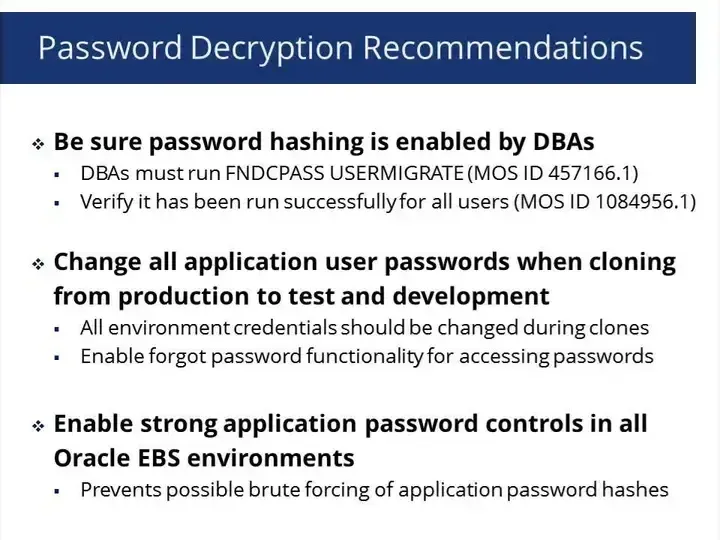
FND_USERstores the APPS password inENCRYPTED_FOUNDATION_PASSWORD, encrypted with the user name and password, and each user's password inENCRYPTED_USER_PASSWORD, encrypted with the APPS password, so the GUEST credentials fromfnd_web_sec.get_guest_username_pwddecrypt APPS, and APPS decrypts every user's password, through thedecryptmethod of the Java classoracle.apps.fnd.security.WebSessionManagerProc.- Encrypted passwords are cloned from production to test and development, where a programmer can read and decrypt them, so change all application user passwords, and all other environment credentials, during every clone, with forgot password functionality enabled for access.
- Hashing, introduced in 11.5.10 RUP6 and 12.0.4 but not enabled by default in any release (including 12.1), drops the encrypted APPS password from
FND_USERand stores user passwords as one-way SHA1 hashes; on 11i, now desupported, it required upgrading every client/server program, such as Application Desktop Integrator (ADI), Oracle Discoverer and Oracle Configurator. - DBAs enabled hashing with
FNDCPASS USERMIGRATE(MOS ID 457166.1), verifying it for all users (MOS ID 1084956.1); as our later webinar New Oracle E-Business Suite Security Features You Can Use Now covers, it is now enabled withAFPASSWD, notFNDCPASS, using SHA512 on 12.1.3+ and 12.2.3+ with patch 26175708. - Enable strong application password controls in every EBS environment, since the hashes can still be brute forced, or use Single Sign-On (SSO) through Oracle Access Manager, so passwords are not stored in EBS (MOS ID 1388152.1).
FND_ORACLE_USERIDstores the passwords of all registered EBS schema database accounts, such as GL, encrypted with the APPS password, so also change all database passwords when cloning from production to test and development, using theFNDCPASSALLORACLEoption.