
Webinar on how to verify that Oracle E-Business Suite is installed, configured and operated securely after a move to a cloud vendor, covering the division of responsibilities, insiders, SOC reports, auditing and encryption.
 Play the Recording: Securing Oracle E-Business Suite in the Cloud
If you are considering moving Oracle E-Business Suite (EBS) to the cloud, you need to know who will handle patching, testing, auditing and security, whether you are comfortable with your cloud vendor's best practices and security protocols, and what information you need to ensure EBS is configured correctly and securely. We examine methods and techniques to "trust but verify" that EBS is installed, configured and operated securely in the cloud.
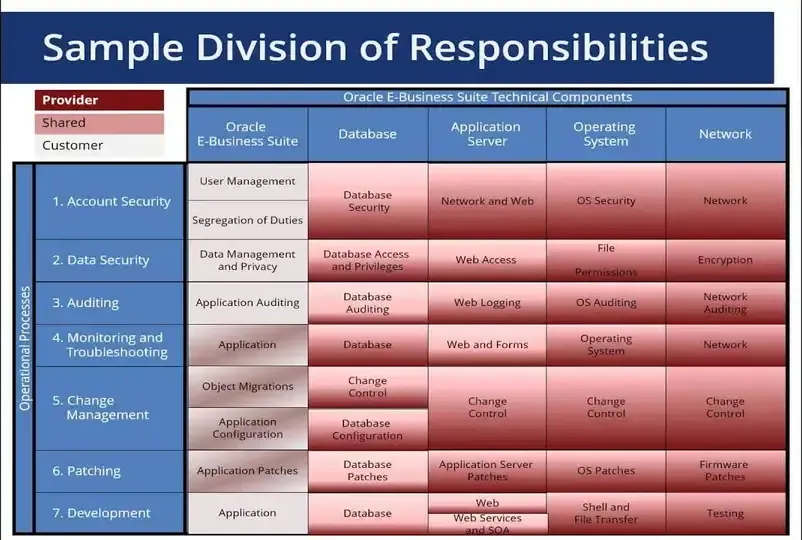
The cloud doesn't change security: you still own your data and are responsible for it. EBS owners, DBAs and auditors can then redraw the lines of responsibility with an IaaS or PaaS provider and verify that the provider meets its share.
Key Points
- Clouds are not new, as IaaS and PaaS used to be called hosting or outsourcing: with either, you still own the EBS application, data and configurations while the provider supplies infrastructure and managed services, so redraw responsibility for account and data security, auditing, monitoring, change management, patching and development, which differs between PaaS and IaaS.
- A cloud provider adds a very large number of insiders to a trust perimeter defined by passwords, which IaaS extends and PaaS even more: EBS has 40+ default accounts and the database and operating system 300+, and the generic accounts are linked, since APPS can obtain the SYSADMIN password and oracle or applmgr can connect as SYSDBA.
- Verify providers with Service Organization Control (SOC) reports, much more effective than contractual or SLA reports: require one annually in the contract, check that it meets your compliance requirements and fits your audit and fiscal periods, and ask for a SOC 2, covering the AICPA Trust Principles, rather than a SOC 1, whose content vendor management chooses.
- EBS by default does not meet most compliance standards, such as HIPAA, SOX and PCI, and you own most requirements, so require adherence to the PCI standard even without card processing, consider independent security assessments, and require syslog feeds of insider OS and database activity to an on-premise logging solution, as in our auditing framework.
- Encrypt data in motion with SSL (today TLS) and at rest with TDE, including backups and VM images, though nothing protects data in use through APPS or the APPS password, and since access to the Oracle wallet controls everything, keep the keys fully in your control, preferably in a hardware security module (HSM).